
At the Edge of What You Can See
On perception, inherited worldviews, and what becomes possible when we begin to notice differently.
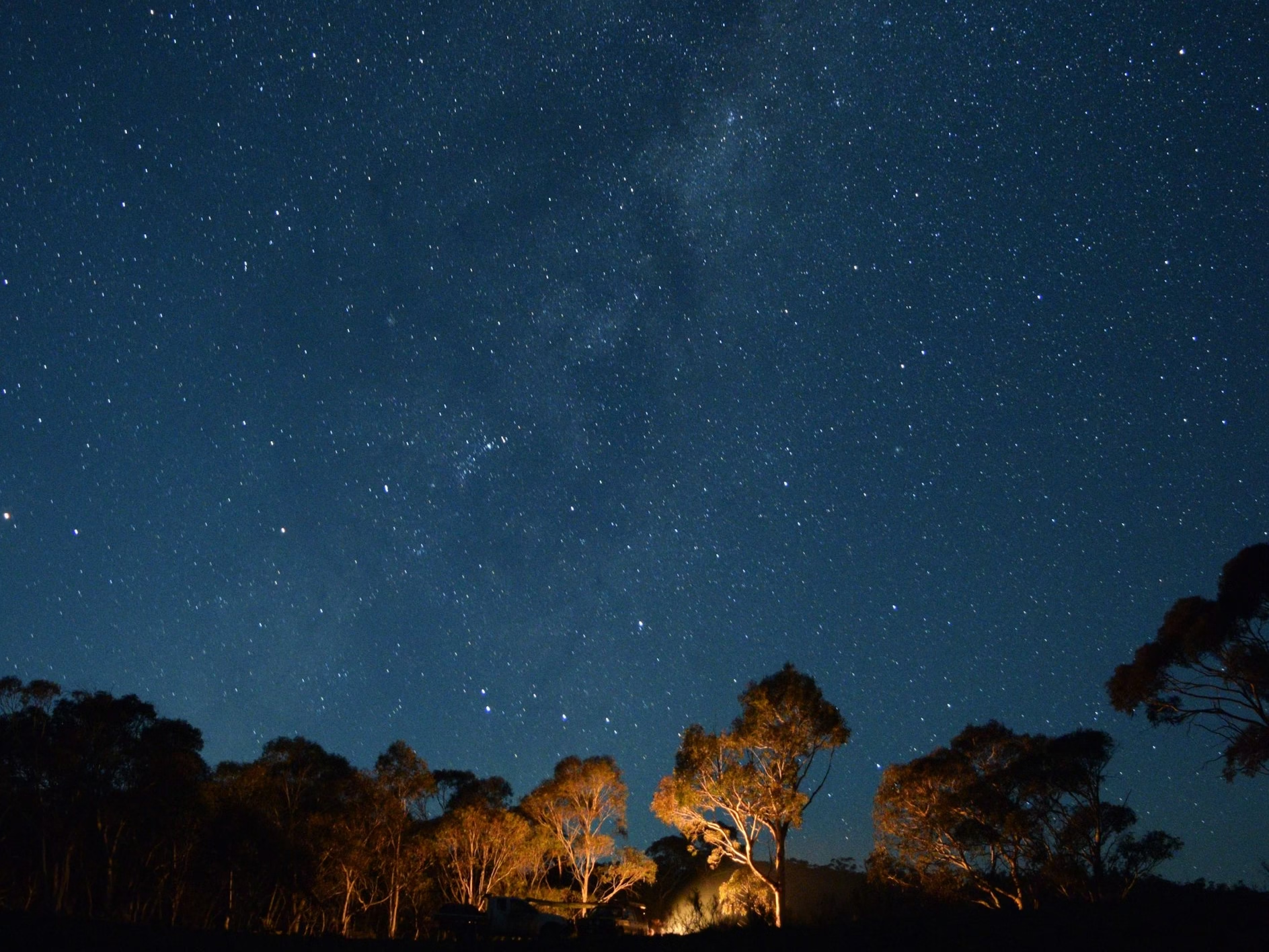
Something attributed to Laurens van der Post’s 1958 book The Lost World of the Kalahari, really struck me when I first read it. In the book he recounts a night spent in the desert with the San people. Whilst gathered around the campfire he told them he couldn’t hear the stars singing. They didn’t believe him at first, looking at his face to see if he was joking. Then two of them quietly led him away from the fire, out under the open sky, and listened with him. One whispered: Do you not hear them now?
He didn’t. He couldn’t.
They walked him slowly back to the small dim circle of firelight and told him they were terribly sorry.
The poet David Wagoner later rendered this moment in verse, capturing what van der Post himself felt: that this was not simply unfamiliarity, but grief as if from a loss. Something that was once possible, and wasn’t anymore. He blamed his ancestors for this, because it was their strange loss of hearing that had become his own.
The human eye contains three types of cone cells. Three! And yet the electromagnetic spectrum is vast beyond comprehension (radio waves, microwaves, infrared, ultraviolet, X-rays, gamma rays). We move through a world saturated with information, signals, and patterns, perceiving an almost laughably thin sliver of what is actually present.
But the funny thing is that we don’t experience this as blindness, as we know, no different. Its simply our reality.
I feel like that is something worth sitting with a moment. Our perceptual world doesn’t actively announce its own limits. What we can perceive simply appears to be the ‘whole picture’, and with the rest just out of frame.
This is not just true of our eyes. It is true of all of our senses, our minds, our cultures, our inherited worldviews, the very language we think in.
In Thirty-Two Words for Field, the writer Manchán Magan recovers lost words of the Irish landscape, words that have no English equivalent, that describe a specific quality of light across a bog, or a particular kind of field depending on what grows there. Among them that stood out for me: five distinct phrases for the stages of a sunrise (Breacadh an Lae, Bánú an Lae, Fáinne Geal an Lae, Súil an lae, Éirí na Gréine).
Five precise, differentiated phrases, each one an invitation to stop, to look more carefully, to notice something specific that sometimes I feel English words miss, with a tendency to collapses into sameness.
The words are not merely descriptive. They are perceptual, helping to train the attention. They say: this matters enough to name, which means it matters enough to see.
Right after school, I spent four months living in the Netherlands with my Mum’s family, and during that time I developed some basic proficiency in Dutch. What surprised me about the experience was less about the negligible practical benefits (the Dutch speak perfect English) and more about how it felt. It felt expansive in some interior way. The Dutch words sometimes had texture, movement, a different relationship to the thing they pointed to. Choosing a Dutch word over an English one, even where they were roughly equivalent, felt like finding a slightly different angle on reality for me. It was as though language weren’t just a delivery mechanism for meaning, but something with its own felt quality. Somehow it opened cracks in my noticing of the world. Particularly words for food, which strangely allowed for a different taste to be experienced, beyond the flavour changes you might expect in a different country.
The Irish language, for whoever carries it, doesn’t just describe the five stages of a sunrise. It makes them visible in the first place.
Which brings me to something harder to sit with.
In The Nutmeg’s Curse, Amitav Ghosh traces the history of the spice trade and its violent aftermath, with the systematic destruction of entire peoples, ecologies, and ways of life in the name of colonial extraction. What strikes Ghosh, and what strikes me, is not just the brutality. It is the perceptual failure at its heart.
Colonisers arrived in places of extraordinary, sophisticated knowledge. Indigenous peoples across the world had developed, over tens of thousands of years, an intimate, intricate relationship with the lands, waterways, skies, and living systems they inhabited. They knew the patterns and moved with the seasons. They communicated with the land in ways that modernity would dismiss as superstition, mythology, the thinking of a “noble savage.”
What the colonisers couldn’t perceive, they deemed not worth knowing. And what they deemed not worth knowing, they were willing to destroy. This wasn’t simply cruelty, though it certainly was that. It was a kind of epistemological arrogance. Its the assumption that one’s own framework for understanding the world was not merely a way of knowing, but the way. That anything falling outside it was ignorance, primitiveness, error.
We are only beginning, slowly and with some humility, to understand what was lost. To recognise that those dismissed knowledge systems contained insights about ecological relationship, about land management, about the intelligence of living systems, that western science is only now finding language for, and most likely holds many of the keys for how we might come to manage the climate and ecological crises we face.
I want to name and own something personal here, because I think it matters.
For much of my life, I operated from a framework that privileged the rational and the explicable. If something couldn’t be clearly articulated and logically defended, it was suspect. If it didn’t make sense within the existing structure of what I understood, it was probably not real, or at best, not worth taking seriously. It felt to me at the time like ‘rigour’, whereas I am only just beginning to recognise what a cage it actually is.
The logic I was applying contains a fatal flaw: it assumes that our current ways of seeing, sensing, and knowing are the arbiters of what exists. That the edges of our perception are the edges of reality. That if I can’t hear the stars, the stars must not be singing.
But I no longer feel like this is ‘rigour’. It is, to borrow van der Post’s word, a loss, that has been masquerading as ‘sophistication’.
Now it is important to acknowledge that none of us consented to the worldviews we inherited, so this isn’t about judgement. They came with the language, the education, the culture, the moment in history we were born into. They shaped what we were able to notice before we even knew that noticing was something that happened. The coloniser’s inability to perceive indigenous knowledge was not simply malice, it was the logical endpoint of a framework that had decided, in advance, what counted.
We are all, in our own ways, living inside versions of that, a system of what Vanessa de Oliveira Andreotti calls Modernity.
Here is what gives me hope rather than despair about this.
Consider mycelium. The vast, subterranean fungal networks that connect trees across a forest, passing nutrients, information, and chemical signals through what mycologists have called the “wood wide web.” For most of western history, soil was considered an inert growing medium. We planted things in it and extracted things from it. We did not imagine it was alive with communication.
When we began to perceive the intelligence of mycelial networks, their connectedness, their distributed processing, the way information moved through them without a central node, we gained more than biological knowledge. The networked, non-hierarchical structure of the internet emerged in part from this kind of thinking.
We built something remarkable because we finally learned to see something that was always there.
And this is what makes me deeply curious, almost restlessly so, about what else is present that we haven’t yet found the perceptual ability for. What patterns exist in living systems, in ecological relationships, in the dynamism of the more-than-human world, that are waiting for us to develop enough perceptual range to receive them?
The rocks we call inanimate were once liquid. Over geological time, they flow, erode, are carried by rivers, shaped by tides. They are only still on our timescale. The mountain is moving. We just don’t perceive with our linear and hyper focused human time horizon.
The Irish words for sunrise don’t just name something that already exists in the perceiver’s awareness. They create the conditions for noticing. The Inuit languages, famously, carry many words for snow because those distinctions are necessary for navigating the world they inhabit. The knowledge is in the noticing. The noticing is in the language. The language is in the relationship.
What we are separate from, we tend to manage, extract from, or ignore. What we are in relationship with, we begin to hear.
And what we can hear, we can learn from.
I am not suggesting we romanticise other ways of knowing, (or we might just colonise indigenous wisdom as well), or that any single tradition holds the whole truth. I am suggesting something simpler and more personal: that the unexamined assumptions shaping our perception are not neutral. They are filtering what is possible for us to notice, to question, and therefore to shift.
The question is not whether our frameworks are limiting us. They most certainly are. All frameworks are, in the way that Alfred Korzybski reminds us that the map is not the territory. The question is whether we are curious enough about the limits to sit at their edges, to listen into the silence, to ask what we might hear if we were willing to not-know for a moment.
The San folk Van der Post encountered were terribly sorry for him, because they knew what he was missing, and they couldn’t give it to him. The hearing wasn’t something you could be handed. It had to be grown, through relationship, through attention, through the slow work of learning to be present in a different way.
That work is available to all of us. Through practice, through sitting in the unknowing, and discomfort that comes with that.
There is so much more to notice than our current frameworks allow. The world is alive with patterns and intelligence and ways of knowing that we are only beginning to find language for. And every time we find language, every time we name a stage of the sunrise we previously walked past, something new becomes available. And this is something we can work with.
The global problems we face are, in large part, created by thinking that couldn’t perceive what it was losing. Meeting them will require something different, but the willingness to fundamentally expand what we are capable of noticing.
That begins with curiosity about the edges of our own perception.
What might you be able to hear, if you stopped being so certain about what sound is?
And what if the edges of your perception aren’t the edges of what exists?
Books referenced and ideas emerging from: Thirty-Two Words for Field by Manchán Magan | The Nutmeg’s Curse by Amitav Ghosh | The Lost World of the Kalahari by Laurens van der Post | The Silence of the Stars, poem by David Wagoner |Nora and Gregory Bateson | Hospicing Modernity by Vanessa de Oliveira Andreotti
I really enjoyed reading this very thoughtful piece. I will explore some of your source books cited, and reflect on your words in my own practice in ecology. Thank you
Thank you for your kind comment Michelle. It was illuminating for me to explore these ideas in the writing process.